
A few years ago in one of our Gazette newsletters, we introduced a new air pressure design called the Power Pipe System™ that uses one inch air pipe in place of multiple half inch pipes. The article described the many benefits of the design, the physical and performance characteristics of the pipe, and how it saves telcos money. It was an attempt to convince our readers that the new design was the best thing since—well, since the Internet.
Ok, so we lied about the Internet part, but the success of the one inch air pipe concept even took us a little by surprise. Today, it's being used by several telcos in a number of wire centers to solve such problems as excessive Code 4s, limited duct availability, poor cable protection, inadequate delivery pressure to cables, and monitoring inaccuracies and deficiencies.
We thought we'd take this opportunity to tell you a little more about the Power Pipe System design and offer some suggestions on how you can use it to "power up" your air pressure system.
Six for One, Half Dozen for Another
One of the biggest problems telcos have today—especially in large urban wire centers—is finding ways to pull new air pipe and/or facilities (such as fiber optic and copper cables) through an overly crowded conduit system. Because a single one inch air pipe can supply approximately the same volume of air as six half inch CA3131 air pipes, there's now a relatively inexpensive alternative to sinking your maintenance budget into new conduit.
Wherever you have multiple half inch air pipes on a route, simply replace them with a one inch pipe. Even if it means just freeing up a couple of sections of conduit, it could be well worth the effort. After all, depending upon where your wire center is located, that first 500 to 1,000 feet of conduit outside the office could be some of the most expensive real estate on the planet.
The "B" Factor
Another benefit of using the Power Pipe System design is that it provides built-in buffering—that mandatory maintenance function that everybody says they do, but ...well, you know.
For clarification, buffering is the process of supplying air to a cable on opposite sides of an open splice case to protect the cable during splicing activity.
Most people don't buffer, not because they don't think it's a good idea, but because they can't afford to spend the time and money it requires. For years, there's been just two ways of buffering. The first one is to place nitrogen tanks on the cable on both sides of the splice (approximately 1,000 feet away), but this requires four additional manhole openings: two to set up the tanks and two more to remove them. This technique significantly reduces the pneumatic section where the splice is located (see Figure 1), and it effectively protects the cable while work is being performed. But, there's all that extra work involved.
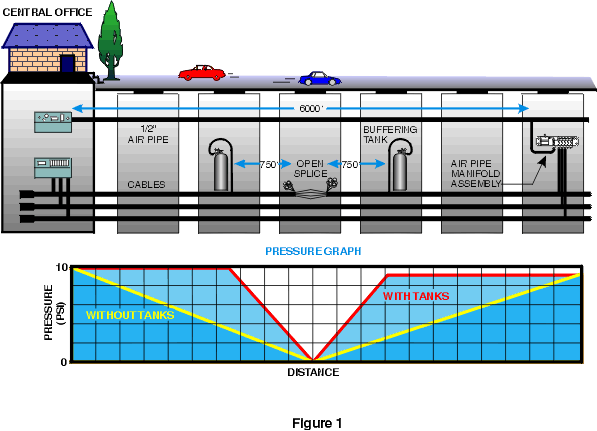
The second method is to use a ½ inch "buffer" pipe for this purpose. Buffer pipe is a classic example of "a great idea, poor execution." Although buffer pipe is an accessible and convenient source of supplemental air, there are some associated problems. For example, the worst thing a technician can do, and it happens way too often, is to leave a buffer hose on after splicing has been completed. This screws up the monitoring system in a big way and makes leak locating much more difficult.
The Power Pipe System is the perfect solution. Typically, in this design air pipe manifolds are spaced 1500 to 2000 feet apart, so the system not only provides built-in buffering, but better overall cable protection as well. The closer manifolds help to keep cable pressures higher throughout the route, and they provide effective buffering points (Figure 2). The larger diameter pipe easily handles any additional flow requirements caused by the closer manifold spacing and splicing activity.
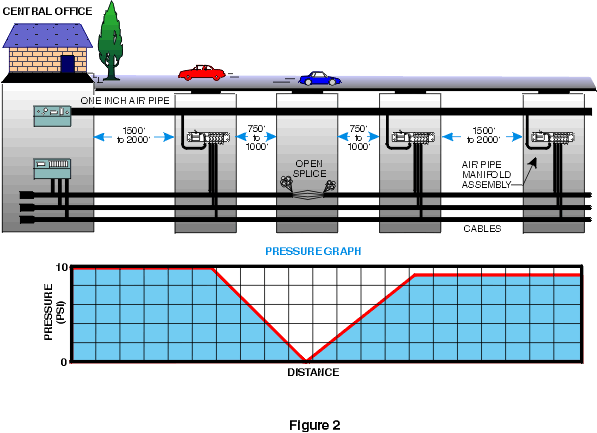
This "B Factor" is an important benefit of the Power Pipe System Design, especially for routes that are traditionally wet, or where there's a lot of traffic (maintenance activity). Just knowing that you've got dual feed buffering protection takes the pressure off you, if you're a splicer, and keeps it inside the cable where it can do some good.
Did We Mention "Wets?"
Basically, the whole point of the Power Pipe System Design is to prevent wet cables in the underground. And it does a far better job of achieving this objective than other air pressure designs.
While the preferred way to reduce Code 4s is to locate and repair the leaks that cause cables to go wet, sometimes this is impossible—especially in highly congested utility holes where access to cables is restricted or impossible. That's where the Power Pipe System Design comes in. With its closer manifold spacing and higher delivery pressure capability, leaks that result in "wets" in a half inch air pipe system may not even be an issue in a Power Pipe System.
So, if you're in charge of reducing Code 4s in the underground—particularly within a short time frame—here's your ace in the hole. Install a Power Pipe System and watch those Code 4s disappear. After all, if you can solve your problems the easy way, more power to you!

© 1996-2018 System Studies Inc. All rights reserved.
(800) 247-8255 | (831) 475-5777